How to Enhance Our Yard Using Talavera Ceramic Mexican Pottery

A slow yard is not as beautiful as a vibrant, colorful unit Mexican talavera pottery. The fact of having complete green bushes, grass, trees and more is not necessarily the finest looking and appealing yard. Among other enhancements, we should muse adding some landscape concern and decor. A fountain, a stone, a tiny hill, an artificial or natural waterfall (not eternal available, of course) and some colorful pottery will finish the trick!

Mexican Talavera pottery is composed of several objects: Pots, planters, wall planters, strawberry pots, clay pottery, figurine pots such as chickens, frogs, donkeys, horses, boots, and a large array of other animal figurines made into a pot. All of the Mexican Talavera pots posses a hole drilled at the bottom of the pot to design water draining easy. They advance in a huge variety of sizes: Vast, large, medium, tiny and mini sizes. Of course, the actual measurements depend on the manufacturer. Speaking of such, unit of the best known brands of Mexican Talavery pottery is Fine Crafts Imports. You can locate this pot brand on Virago, Houzz, EBay, Walmart and of course on their main website.
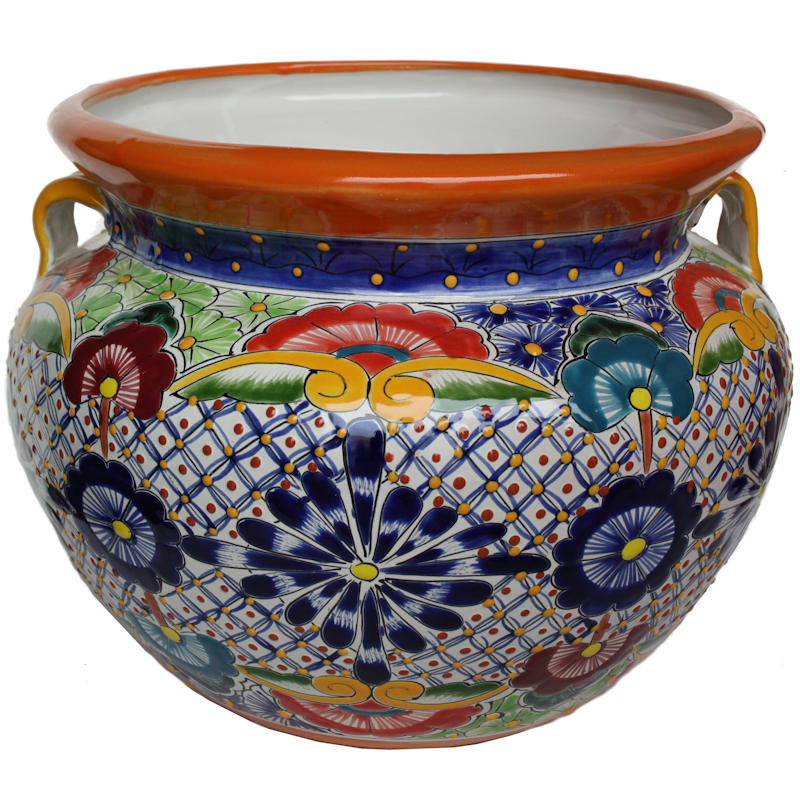
Talavera pottery is known to be composed of very vibrant colors, be cautious when choosing your pot because they can be too colorful whether they are not chosen carefully. This, of course, depends on your home garden decor Mexican pottery. What colors are predominant in your garden, what colors you like the most, and what size will fit your needs. Fortunately, there are some designs that approach in very soft and traditional colors (blue and white) that will most likely fit a wide range of home decor styles. Southwestern, California revival, Mexican and Spanish dwelling decor styles will benefit the most of these handsome products as they are specifically designed for these styles. That does not necessarily affect that a modern, contemporary residence decor design will not benefit from the lulu of these artifacts.

Painting using the Talavera design is an ancient trade that originated most likely in the Middle East, brought into Morocco, Italy, Spain and lately (sixteenth century) to Mexico. Mexico is known to employ colorful glazes to magnify Mexican dwelling decor gave a very pleasant welcome to this technique and started implementing their own cultural ideas into the original paintings and colors.

Continue Reading →

How Handmade Home Number Tiles Can Be Used To Enhance Your House Entrance

Though some homes also hold names, entire houses are normally identified by their house number for government property records. Hence your place owners should ensure that their home number is easily visible, so that visitors and others can find the home easily. While plastic and metal signs can be used for house numbers these are not durable or may score corroded after some moment since they are placed outdoors. Hence increasingly your place owners are preferring to use Talavera House Number Tiles for their homes since these ceramic tiles are appealing, durable and do not require much maintenance. Additional information about Talavera tiles for house number is if under.

History

The Talavera tiles were first produced and used in the town of Talavera de la Reina in Spain Fine Crafts Imports. The region also had Dutch and Arabic settlers who contributed to the development of the tiles. Tin glazing techniques developed in Italy were used to furnish the tiles their distinctive milky white veneer. Next the Spanish conquest of Mexico, the Spanish monks wanted the churches being constructed to have the Talavera tiles which they were familiar with. Puebla a town in Mexico has volcanic deposits and clay which is suitable for making the Talavera tiles. Hence the town became renowned for the Mexican Talavera tiles.

Making tiles

Though some companies are selling machine made tiles as Talavera tiles, the original Talavera tiles are handmade, using a extensive and laborious process. The clay is first soaked in water for several days so that the clay can be kneaded into the appropriate shape. The clay is slash into blocks which are to be converted into tiles, first dried in the gloomy and then in sunlight. The tiles are then fired in the kiln, glazed by dipping them into the liquid glaze and dried. Next this the tiles are hand painted in the different patterns, so that each tile is unique. Subsequent this the tiles are again fired in a kiln at a temperature of 1000 degree centigrade.

Number tiles

Since handmade Talavera tiles are expensive, using them on the outside of the house is an indication of the prosperity of the home owner. To make it easier to identify the dwelling, Talavera tile are used with the house number. Typically each tile will possess a separate number. These tiles are available in dissimilar sizes and patterns. The tiles are defined by the height of the tiles, if the house number is to be visible from a longer distance, the tiles should be larger in size. Depending on the space available for installing the tiles, the dwelling owner should order suitable tiles.

Patterns

In addition to the number, each Talavera tile will posses a pattern in distinct colors click here. Depending on the design of the home, a suitable sample should be selected. The blue color pigment used is most expensive, so numerous of the current patterns use this blue color. Other colors used for the patterns include green, mauve, red and yellow. The tiles can be fixed on the walls using an adhesive or an iron frame for hanging on the wall can be used.

Continue Reading →